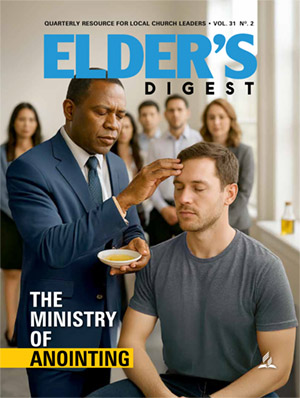
Imagine you have been elected and ordained as a local elder of the congregation. Then tragedy strikes. You are informed that Sister Smith is in the local hospital and her condition is serious. You go and visit her. She tells you she does not expect to live long. She would like special prayer now. You remember a text: “Is anyone among you sick? Let him call for the elders of the church, and let them pray over him, anointing him with oil in the name of the Lord. And the prayer of faith will save the one who is sick, and the Lord will raise him up. And if he has committed sins, he will be forgiven” (Jas 5:14–15, ESV).
You know little about anointing and have never seen one. How should you respond? What should you do?
As a young pastoral intern, I was assigned a district of three churches in a small town with only one doctor and a clinic. The nearest hospital was sixty-five miles away. The worst happened that tested my inexperience when an auto crash severely injured a church member. As soon as the call came, I went to the clinic to see her. As I arrived, the community’s sole doctor was coming out of her room. He told me, “Pastor, I have done all I can do. Her condition is too critical for movement to a hospital. She may not live through the night. The rest is up to you and God.” Though her injuries were obvious, she recognized me and seemed glad for my presence. I felt helpless, but after sharing some words of assurance and a brief prayer, I asked if she would be open to anointing. She was not certain what anointing was, so I read the text from James 5.
She then asked that anointing be done. Anointing had not been taught during my years at the seminary, and I had not participated in one previously. So now what?
Fortunately, the elders in my assigned churches were far more experienced spiritual leaders and even preachers than I was. I contacted the first elder, who often proved to be a wise father-type mentor to me, or I may not have survived those early years of unsupervised ministry. We prepared and conducted a service that evening. Our faithful member lived through the night, transferred to a hospital, and after being thoroughly examined, was released for home.
Two days later, she came to the parsonage in person to thank my wife and me for our prayers and visit. We were amazed to see her looking so well. She believed her life was miraculously spared and God had divinely healed her injuries. We all agreed.
In the years and anointings since, nothing that intense has occurred. In fact, several persons have died after being anointed. Others have slowly recovered of illnesses and injuries, seemingly in response only to medical care and treatments by professionals.
Anointing raises several questions to ponder and pray about before rushing to practice:
1. WHAT IS THE INTENDED PURPOSE AND EXPECTED OUTCOME OF ANOINTING?
You may be asked by an Adventist or their family members to anoint a person. In some cases, the patient could be terminal or unresponsive. In exceptionally unusual situations, you might be asked to anoint a nonAdventist believer. Would you be willing to do so?
Each of the Gospels relate Mary anointing Jesus at Simon’s feast a week prior to His death with expensive fragrant oil (Matt 26:6–13; Mark 14:3–9; Luke 7:36–50; John 12:1–9). Jesus commended her caring act. Are such requests a type of “last rites” either hoping for a miracle, or a last confession before departing life? Perhaps they are a farewell testimony of faith, such as Paul gives in 2 Timothy 4:6–8. Though it can be a final act of ministry to the living, it is not an “Adventist sacrament of last rites.”
Throughout Scripture anointing appears used for several purposes: (1) ordinary use of oils for personal reasons, such as to relieve skin dryness; (2) official recognition of priests (Aaron and his sons), prophets (Elijah anointing Elisha), and kings (Saul, David, Solomon, and Hazael of Syria); and (3) healing as done by the disciples on the first missionary journey (Mark 6:13), and by the Good Samaritan for the victim of robbery (Luke 10:34).
Obviously, the biblical use of anointing is intentional, prayerfully planned, and for spiritual purposes. The Scriptures teach we are to respect and care for our bodies responsibly (1 Cor 6:19–20; 3:16; 10:31). Using anointing as an antidote or “quick fix” for a common cold or upset stomach could be an inappropriate presumption. Does the Lord heal “minor” disease? Of course! All healing comes from following divine physical law. Medical science optimizes the created body to receive divine healing. Frivolous use of something special, even sacred, makes it common and less meaningful.
When agreeing to anoint, make sure the patient and all those present or giving prayers understand that anointing does not create some magic that causes healing, nor does the oil itself heal. That thinking borders on believing in the “charlatans of modern healing ministries” that televise miracles for publicity and profit.
2. WHAT SHOULD BE CONSIDERED IN PREPARING FOR THE ANOINTING?
The Seventh-day Adventist Minister’s Handbook provides clear and concise guidance.1 Since this book may not be readily available to elders, its guidance is summarized here.
Request for Anointing. Normally, if able, the afflicted asks to be anointed. However, not all believers or church members are aware of this option. An inquiry can be made to the patient, “Are you aware of the option for anointing?” Many church members do not know or think about anointing. If the afflicted person is unable, family and friends may make the request for the sick or injured. The anointing service is a personal event that addresses sickness and forgiveness as needed. It is a time of reflection and commitment to the will of God’s restoring power and grace.
The anointing service is a personal event that addresses sickness and forgiveness as needed.
Officiants. The pastor usually leads, assisted by the presence and prayers of church elders. If a minister is not available, other spiritual leaders who believe in divine healing can do so with the approval of the pastor or other minister.
Location. Depending on the circumstances, the location can be wherever the need arises. If the anointing will be inside a medical facility, coordinate with the medical staff ahead of time to minimize any interruption and permit some privacy.
Recipient. Anointing is not intended as a time to prompt confession of past sins. Most people are aware of sin in their lives and may even feel their suffering is divine punishment. When the request for anointing is first made, the pastor or visiting elder has the opportunity to tactfully encourage the recipient to examine their heart and their relationship with God, rather than during the anointing service. The recipient may be inclined to mention any doubts or concerns during the privacy of that visit rather than before a group at the anointing. When that has been sought by the recipient, assurance of forgiveness and grace can be made confidently in the prayers offered.
Other Attendees. The recipient may wish family members or friends to be present, some of whom may not be believers. It is okay for them to remain.
3. HOW SHOULD THE ANOINTING BE CONDUCTED?
Have a plan and order of service before entering the presence of the recipient. While the anointing should not appear as a programmed or a staged event, the anointing should be orderly. The leading officiant should stand where the recipient can easily see them (usually near the patient’s head); the others can stand beside the recipient.
Order of Service. Introducing those who will have a part in the service also gives an order of participation. Give a brief explanation of the purpose for anointing and how it will occur. Read appropriate Bible passages and then let each one who was asked to pray offer prayer beginning with the one being anointed, if he/she so desires. The pastor or leader should pray last and, at the conclusion of the prayer, place a small drop of anointing oil on the recipient’s forehead (be careful to avoid the oil running into an eye or any open wound; use a cotton ball or have a tissue handy). While a variety of special oils can be bought from church supply stores, any clean and fresh olive oil (not rancid) is fine for anointing. Do not attempt to pour or place oil directly on the affected parts of the recipient’s body. The anointing oil must only be placed on the forehead.
Prayer. A number of suggested prayers to offer at an anointing can be found on the Internet or generated by AI, but they may not always reflect the teachings of the Bible. Adventist elders would be wise to carefully study what the Bible says about God’s will and healing. The Ministry of Healing offers some profound insights, especially in chapters “In the Sickroom” and “Prayer for the Sick.”2
God chooses how to exercise and reveal His will in response to our needs and requests. Let Him be God!
Conversation. During any visitation to a sick or injured person who may appear unconscious or in a comatose state, wisely continue to guard what is said. Medical workers believe the sensory perception that lasts the longest is hearing. Though the patient may not be able to respond, they may be able to sense what is being said.
Departure. After the anointing has taken place, express a word of blessing, leave a calling card on how to be reached, and quietly depart. If the anointing has taken place in a hospital, stop by the nurses’ station and thank them for their caring service and time allowed for the anointing.
Anointing complements preaching the Gospel with praying for healing of the sick or injured. Balance is key in ministering for others. Even though what appears as a miracle may occur from anointing, Christ is the Great Physician and Miracle Worker. To Him be all glory! Never project the image that you are a miracle worker. Miracles are God-given opportunities extended to weak human beings to use the benefit for praising and honoring God by a further life of doing His will in grateful service. Anointing does not heal. Through the prayer of faith, Christ grants His grace and mercy to pardon sin and heal the body.
Anointing complements preaching the Gospel with praying for healing of the sick or injured.

1 General Conference of Seventh-day Adventists Ministerial Association, Seventh-day Adventist Minister’s Handbook (Silver Spring, MD: General Conference of Seventh-day Adventists Ministerial Association, 2009), 189–192.
2 Ellen G. White, The Ministry of Healing (Mountain View, CA: Pacific Press, 1905).
Gary R. Councell is a retired teacher, pastor, chaplain, and departmental director. Immediately prior to his retirement he was the director of Adventist Chaplaincy Ministries at the General Conference of Seventh-day Adventists, Silver Spring, MD, USA.