One in five children will experience child sexual abuse or exploitation.1 One in six women and one in sixteen men have experienced physical and/or sexual violence by a current or previous partner since the age of fifteen.2 These are shocking statistics. Perhaps you have heard of them before? Maybe they feel so overwhelming that it’s hard to know where to begin? These Australian figures are, unfortunately, consistent with global estimates—particularly when it comes to child sexual abuse.
But we must begin, because this is happening inside the church too. In the Australian Royal Commission into Institutional Responses to Child Sexual Abuse, 59% of disclosures related to abuse occurred in a faith-based setting.
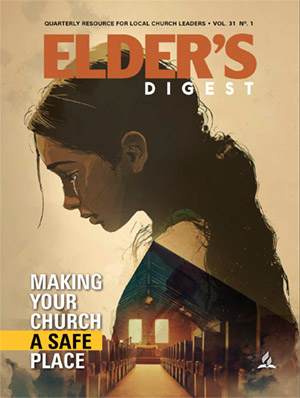
This is the first in a series of five articles developed for Elder’s Digest by Adsafe, the child and vulnerable adult protection agency of the Seventh-day Adventist Church in the South Pacific Division. Adsafe was established to help protect children and vulnerable adults from sexual and physical abuse in church settings by equipping leaders and members with the knowledge, tools, and confidence to prevent abuse, respond appropriately when concerns arise, and uphold a culture of care and accountability.
As church leaders, we hold a sacred trust to care for those we serve. Many of us have witnessed firsthand the impact of abuse—how it can shatter a child’s sense of safety, fracture families, and disrupt entire congregations.
Elders are called to be shepherds of the flock, a role that includes protecting the most vulnerable among us. While legal and regulatory obligations guide us in many countries, our deepest calling is biblical and moral.
Survivors of abuse are often voiceless and marginalized, unable to advocate for themselves. They need us—followers of Jesus Christ—to act on their behalf. The Royal Commission found that over 90% of allegations are true. As believers, we must approach disclosures with a posture of listening and believing.
Scripture calls us not only to proclaim truth, but to create environments that are safe, respectful, and nurturing—especially for children and vulnerable adults. This is the essence of disciple-making.
What guidance does Scripture and the writings of Ellen G. White offer to help us respond well?
How do we move from good intentions to a strong, biblically grounded framework that prevents abuse and responds faithfully when it occurs?
THE IMAGE OF GOD AND HUMAN DIGNITY
Genesis 1:27 teaches that every human is made in God’s image. This foundational truth confers inherent worth and dignity on every person— child, elderly, disabled, or dependent. Abuse, then, is not only a personal violation; it is an assault on the image of God in another. Every person, and especially children and vulnerable adults, is precious in God’s sight.
JESUS’ SPECIAL CONCERN FOR CHILDREN
Jesus demonstrated love and protection for children. In Matthew 18:5–6, He issued one of His strongest warnings: “If anyone causes one of these little ones . . . to stumble, it would be better . . . to be drowned in the depths of the sea.”3
These are not casual words. Jesus makes clear that harming a child is a grave offence. The care and protection of children is not optional; it is a divine imperative.
In Mark 10:14 Jesus insisted, “Let the little children come to me . . . for the kingdom of God belongs to such as these.”
Jesus didn’t see children as marginal, but as central to His Kingdom. Ellen G. White echoes this care when she writes, “He knows the burdens of every mother’s heart. . . . He sympathizes with every Christian mother in her cares.”4 As church leaders, we are called to mirror this compassion and protectiveness.
GOD’S HEART FOR THE VULNERABLE
God’s concern for the vulnerable runs throughout Scripture—not only for children, but for all who are weak, dependent, or oppressed. Psalm 82:3–4 commands, “Defend the weak and the fatherless; uphold the cause of the poor and the oppressed. Rescue the weak and the needy.”
Isaiah 1:17 echoes this: “Learn to do right; seek justice. Defend the oppressed. Take up the cause of the fatherless; plead the case of the widow.”
Throughout the Old and New Testaments, God’s people are consistently called to act on behalf of those who cannot stand for themselves. Failing to protect the vulnerable is not just a moral lapse; it is disobedience to God’s clear commands.
Failing to protect the vulnerable is not just a moral lapse; it is disobedience to God’s clear commands.

LOVE AND JUSTICE: CORE TO CHRISTIAN ETHICS
At the heart of Christian life is love. Romans 13:10 reminds us, “Love does no harm to a neighbor. Therefore love is the fulfillment of the law.”
Abuse is the opposite of love. It is an act of betrayal of trust and distortion of God’s intent for human relationships. As Micah 6:8 puts it so simply and profoundly, “He has shown you, O mortal, what is good. And what does the Lord require of you? To act justly and to love mercy and to walk humbly with your God.”
To protect the vulnerable is not a peripheral task; it is a central expression of our faithfulness to God. When we fail to do so, we betray the very character we are called to reflect.
THE CHARACTER OF GOD’S PEOPLE
Safeguarding children and vulnerable adults is not just a legal or organizational responsibility. It is a core expression of biblical discipleship.
In John 13:34–35, Jesus gives us this command: “So now I am giving you a new commandment: Love each other. Just as I have loved you, you should love each other. Your love for one another will prove to the world that you are my disciples” (NLT).
What this tells us is that Jesus cares deeply about how we treat one another—our conduct, our attitude, our behavior. This is echoed in the well-known passage from Galatians 5:22–23, which describes the fruit of the Holy Spirit: “Love, joy, peace, patience, kindness, goodness, faithfulness, gentleness, and selfcontrol. Against such things there is no law” (NET).
To protect children and vulnerable adults is to reflect the very heart of God.

MORAL AND ETHICAL IMPLICATIONS
- Abuse is sin. It violates the command to love, exploits power, and shatters trust. It is not just a personal failing; it is against God’s will for human relationships.
- Silence is complicity. Ignoring, minimizing, or failing to address abuse is a moral failure. It contradicts the biblical call to justice, mercy, and truth.
- Protection is discipleship. To follow Jesus is to stand against harm, defend the vulnerable, and create communities marked by safety, compassion, and accountability.
A CALL TO ACTION
Our conduct, vigilance, and willingness to act reveal the depth of our integrity and our obedience to Christ. It is not enough to preach righteousness from the pulpit while remaining silent about abuse in the pews or classrooms.
We are called to foster a culture where abuse is not tolerated; where survivors are heard, believed, and supported; and where strong systems are in place to prevent harm. This is not merely about policies or legal obligations. It is about living out the Gospel in courageous and compassionate ways. It is about reflecting the character of Christ in how we lead and serve.
Protecting children and vulnerable adults, and responding faithfully to allegations of abuse is not just an administrative task; it is a spiritual mandate.
PRACTICAL STEPS FOR LEADERS
- Educate yourself and your team. Learn what abuse looks like, how grooming occurs, and what red flags to watch for. Knowledge empowers action.
- Establish clear safeguarding policies. Every church should have practical protocols in place covering background checks, mandatory reporting, appropriate boundaries, and safe practices for all who work with children and vulnerable adults.
- Create a culture of openness. Make it safe for children and adults to speak up. Remove the stigma around reporting, and support those who come forward.
- Respond quickly and justly. Never conceal abuse. Follow the law and your policies. Respond with compassion to victims and take swift action to ensure safety.
- Pray and lead spiritually. Seek God’s wisdom, courage, and protection. Teach your congregation about God’s heart for justice, mercy, and care for the vulnerable.
CONCLUSION
To protect children and vulnerable adults is to reflect the very heart of God. As leaders, we cannot claim to follow Christ while ignoring or enabling abuse. We are called to be shepherds, not only in word, but in action—defenders of the vulnerable, champions of justice, and safe harbors for the wounded.
This is more than a legal obligation. It is a sacred trust, a moral and spiritual mandate grounded in Scripture and embodied in the life of Christ Himself.
I dream of a church where every person is treated with dignity and respect, recognized as bearing the image of God. I dream of a thriving church where abuse has no place and healing begins.
OFFICIAL CHURCH STATEMENTS
“Statement on Abuse and Family Violence” (1995), https://gc.adventist.org/ official-statements/statement-on-abuse-and-familyviolence/.
"Child Sexual Abuse” (1997), https://gc.adventist.org/ official-statements/childsexual-abuse/.
“Well-Being and Value of Children” (2000), https://gc.adventist. org/official-statements/ well-being-and-value-ofchildren/.
“Ending Violence Against Women and Girls” (2010), https://gc.adventist.org/ official-statements/endingviolence-against-womenand-girls/.
“Nurture and Protection of Children” (2010), https://gc.adventist. org/official-statements/ nurture-and-protection-ofchildren/.
1 https://bravehearts.org.au/double-your-impactbravehearts-urges-australians-to-donate-to-helpprotect-children-against-child-sexual-abuse.
2 https://www.aihw.gov.au/reports/family-domesticand-sexual-violence/family-domestic-sexualviolence-in-australia-2018/summary.
3 All Scripture references are from the NIV, unless otherwise indicated.
4 Ellen G. White, The Adventist Home (Hagerstown, MD: Review and Herald, 1952), 204.
Michael Worker is the general manager of Adsafe, the child protection agency for the Seventh-day Adventist Church in the South Pacific Division.